Hall MHD models solve the following governing equations of ion mass density \(\rho\), magnetic field \(\mathbf{B}\), ion bulk velocity \(\mathbf{u}\), total thermal pressure \(p_t=p_i+p_e\):
The Hall electric-field term, \((\mathbf{J}\times\mathbf{B})/(e n_e)\), does no direct electromagnetic work because \(\mathbf{J}\cdot(\mathbf{J}\times\mathbf{B})=0\). The Lorentz force, \(\mathbf{J}\times\mathbf{B}\), can still exchange energy with the ion bulk flow through the momentum equation. BATSRUS typically solves the conservative form of these equations. Similarly, the HMHD equations above can be extended to a two-fluid MHD formulation by adding the electron pressure-gradient term, \(\nabla p_e/(e n_e)\), to the electric field \(\mathbf{E}\) and by solving a corresponding energy equation for \(p_e\). The ion momentum equation already includes the electron pressure contribution, so it does not need to be modified.
Notation: \(\mathbf{I}\) is the identity tensor, \(B^2=\mathbf{B}\cdot\mathbf{B}\), \(\mu_0\) is the vacuum permeability, \(e\) is the elementary charge, \(\eta\) is the resistivity, \(\gamma\) is the adiabatic index, and \(\mathbf{G}\) is an external force density. The electron pressure-gradient term, \(-\nabla p_e/(e n_e)\), is omitted in the simplified Ohm's law above. If \(\mathbf{G}\cdot\mathbf{u}\) represents direct thermal heating rather than mechanical work, it should be added explicitly as a heating source.
Many commonly quoted ion inertial length \(d_i\) formulas are written in cgs, including wiki. I write it in SI here: \(\lambda_i=\sqrt{ \frac{m_i}{\mu_0 e^2 n_i} }\)[Toth et al. 2017].
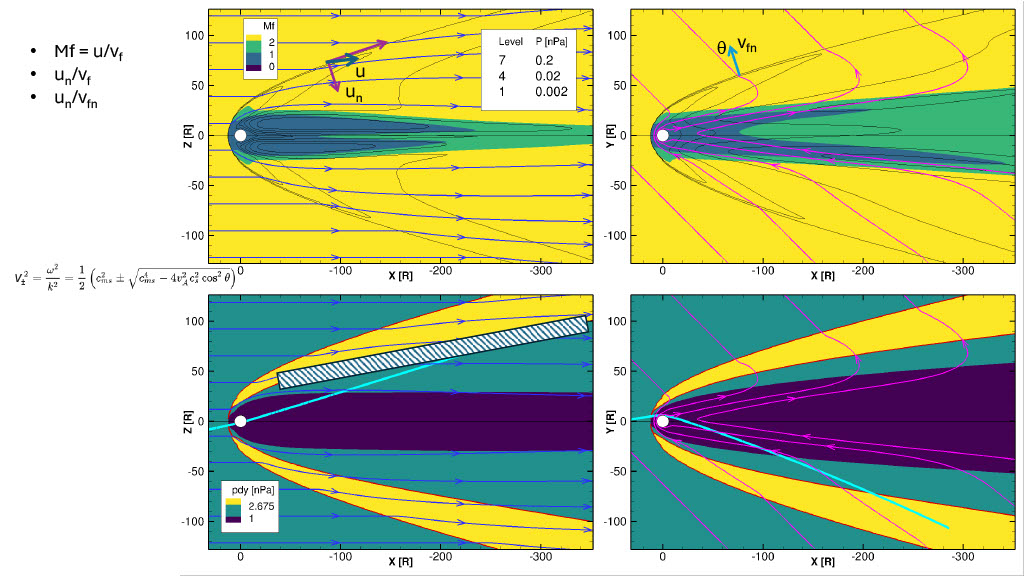
Solar wind interacting with Earth dipole. These figures show how parameters change at the shock and the pile up boundary. We show a large domain to exhibit the oblique shock regions.
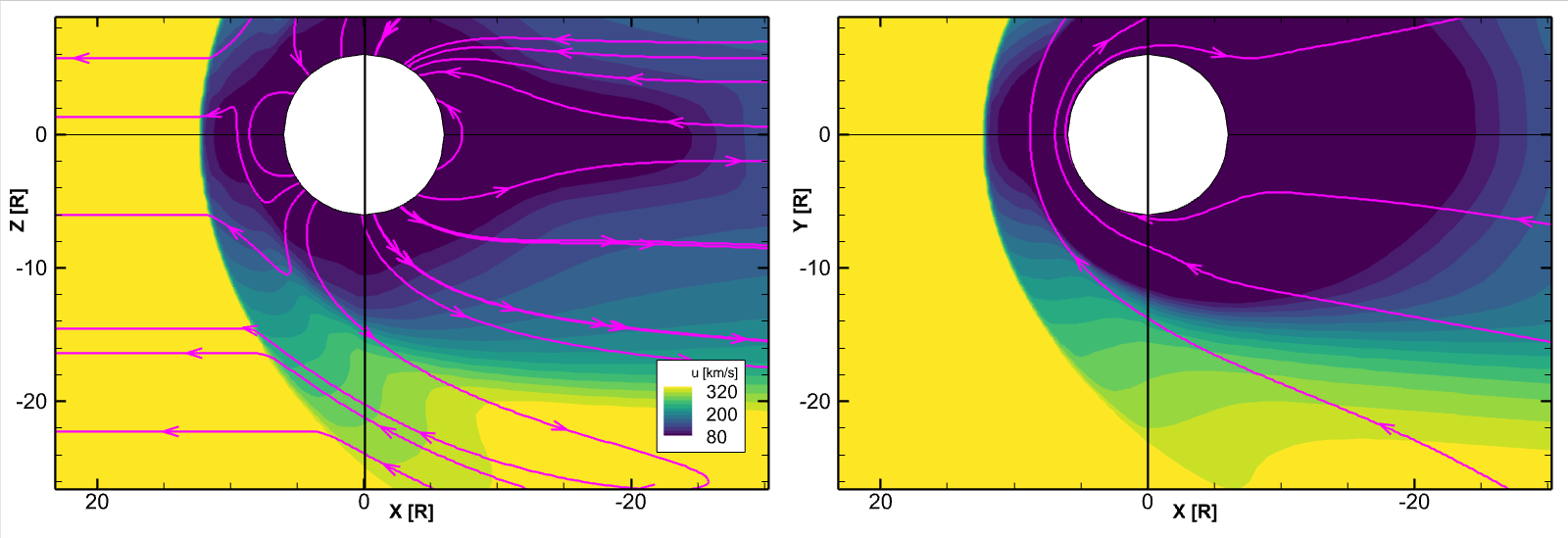
At the dawn-dusk terminator, flow shear is still only ~100km/s.
More Visualizations: thousands by NASA. I recommend 3570, 4188, 5502, 5425, 14202, 2387. What I do not find informative enough: 14907; 5536
yingdong at ucla.edu · Address: Slichter Hall 6873, 595 Charles E Young Dr E, Los Angeles, CA 90095.
